
Lithium vs AGM: Which Battery Is Right for Your Motorhome?
Your motorhome’s battery system is the part of the build most buyers think about least before purchase and most about once they are on the road. Whether you are running a compressor fridge overnight, charging devices without shore power, or watching TV after dinner at a remote camp, everything draws from the same bank. Get the battery wrong for how you travel, and you will either feel short-changed or wonder why you paid for capacity you never needed.
This guide explains the real-world difference between AGM and lithium iron phosphate (LiFePO4) batteries, how each performs in Australian touring conditions, and which Suncamper models come with which system as standard.
What Is an AGM Battery?
AGM stands for Absorbent Glass Mat. It is a sealed lead-acid battery where the electrolyte is held in fibreglass matting between the plates rather than in free liquid. This makes AGM batteries spill-proof and maintenance-free, which is why they became the standard leisure battery in motorhomes and caravans.
AGM batteries are reliable and well-understood. Most RV technicians across Australia can service and replace them without issue. They charge from solar, a DC-to-DC charger, or mains power without any special compatibility concerns.
The main limitation is usable capacity. You should not discharge an AGM battery below 50 per cent of its rated capacity without shortening its lifespan. A 240Ah AGM bank therefore gives you roughly 120Ah of usable power before you need to start recharging. In practical terms, that is two or three days off-grid for a typical couple before the fridge starts drawing on capacity you cannot spare on an overcast day.
Cycle life is also lower than lithium. A quality AGM battery rated for 500 cycles at 50 per cent depth of discharge will last two to three years of regular touring before capacity starts to drop.
What Is a Lithium Battery?
When motorhome manufacturers refer to lithium batteries, they mean lithium iron phosphate (LiFePO4), not the lithium-ion chemistry used in laptops and phones. LiFePO4 is a chemically stable, thermally safe battery well-suited to the heat and vibration of Australian touring.
The headline advantage is usable capacity. You can discharge lithium to 80 per cent of rated capacity without harming the battery. A 400Ah lithium bank gives you 320Ah of usable power. That is more than double the usable output of a 240Ah AGM system, even before accounting for lithium’s lower internal resistance and faster charge acceptance.
Cycle life is the other significant difference. A quality LiFePO4 battery is typically rated for 2,000 to 3,000 cycles at 80 per cent depth of discharge. Suncamper’s lithium batteries are covered under their own manufacturer warranty, separate to Suncamper’s structural build warranty. With proper care, many owners get useful life well beyond the battery’s rated cycle life.
Lithium also accepts charge faster than AGM. Where an AGM battery slows charge acceptance as it approaches 80 per cent full, lithium continues accepting a high charge rate almost to full capacity. In practice, your solar array fills a lithium bank faster and more completely on a given day.
The trade-off is upfront cost. Lithium batteries cost more than AGM at equivalent capacity, and the total system cost typically includes a more capable inverter and a compatible DC-to-DC charger. They also require a battery management system (BMS), which is built into quality lithium batteries and manages cell balancing, over-charge protection, and temperature cutoffs.
One Thing Most Buyers Do Not Know: Recovery from Flat
There is a practical difference between AGM and lithium that does not show up in spec sheets but matters a great deal if you are travelling remotely.
If an AGM battery goes flat, you can typically still turn the vehicle over and drive away. Once the engine is running, the alternator charges the house battery through the DC-to-DC charger, and the system comes back to life as you travel. No intervention required.
A lithium battery behaves differently when it reaches its lower voltage threshold. The BMS cuts output to protect the cells, and once the battery enters protection mode, simply connecting a DC charging source is often not enough to wake it back up. In many cases you need a 240v mains connection to supply sufficient charge to bring the BMS out of protection mode. If you are camped somewhere remote without access to a powered site, a generator, or a jump-start unit capable of supplying 240v, recovering a flat lithium battery can be a real problem.
This is not a reason to avoid lithium. With adequate solar, a properly sized DC-to-DC charger, and realistic capacity for your actual usage, a lithium battery in a well-specified motorhome should rarely reach that protection threshold. But it is worth understanding before you choose, particularly if you regularly travel to very remote areas far from powered infrastructure.
If this concerns you, the conversation to have is at order stage, not after you take delivery. Ensuring your solar capacity is sized correctly for your power draw, and understanding what recovery options you carry with you, removes most of the risk.
AGM vs Lithium: Side by Side
| AGM | Lithium (LiFePO4) | |
|---|---|---|
| Usable capacity | ~50% of rated | ~80% of rated |
| Cycle life | 300 to 500 cycles | 2,000 to 3,000+ cycles |
| Weight | Heavier | Lighter (typically 30 to 50% per amp hour) |
| Charge speed | Slower, tapers near full | Fast, consistent to near full |
| Cold weather performance | Reduced at low temps | Better retention, BMS protects below 0°C |
| Recovery from flat | Start the vehicle and drive | Requires 240v in most cases |
| Upfront cost | Lower | Higher |
| Compatibility | Universal | Requires compatible charger and MPPT |
| Lifespan | 2 to 3 years heavy use | Manufacturer warranty applies |
Which Battery System Is Right for You?
The answer depends on how you actually travel, not how you hope to travel.
AGM suits you if you do most of your touring at powered sites or on shorter trips with regular mains access. If you are plugging in at caravan parks most nights, your battery bank rarely needs to do heavy overnight work and the cost premium of lithium is harder to justify. AGM is also a sensible fit for entry-level buyers who want to keep the initial outlay manageable and know they can upgrade later if their travel style changes.
Lithium suits you if you spend a significant amount of time off-grid. Freedom camping in national parks, remote stations, or coastal reserves away from powered sites is a different experience with lithium. You run your compressor fridge without watching the monitor. You use 240v appliances after dark without anxiety. You wake up with capacity to spare. For buyers who travel that way regularly, the upfront cost of lithium typically pays back over three to five years compared to replacing AGM batteries on a two-to-three year cycle.
Lithium is also worth considering if payload is a constraint. A lithium battery of equivalent usable capacity is considerably lighter than an AGM bank. On cab-over builds like the Sherwood range where payload management matters, that weight saving is meaningful.
One honest note: if you end up somewhere remote with a flat lithium battery and no 240v source, recovery is not simple. With correct sizing and adequate solar this should not happen in normal touring use, but it is worth understanding before you commit.
Battery Systems Across the Suncamper Range
Here is what each model comes with as standard, and what is available as an upgrade.
Sherwood R-2
The R-2 comes standard with a 120Ah AGM battery. This suits the R-2’s positioning as an entry-level model for a mix of powered and unpowered sites. Solar and an inverter are available as options. If you plan to spend significant time off-grid, discuss a lithium upgrade at order stage.
Sherwood E-2 and T-2
Both models come standard with 240Ah AGM batteries, 260w of solar, and a Victron MPPT solar controller. A Victron DC-to-DC charger is standard across all Sherwood models. A lithium upgrade is available as an option ($1,700, minus 30kg from your payload), and pairing lithium with an inverter is the combination that makes serious off-grid travel practical in these models.
Sherwood Conqueror 2.0
The Conqueror 2.0 comes standard with a 400Ah lithium battery, 600w of solar, a 120-amp 240v battery charger, a 3,000w pure sine inverter, and a Victron MPPT solar controller. It is built from the ground up as an off-grid system. You can upgrade to 600Ah by adding a further 200Ah of lithium at order stage. This setup is sized specifically for extended remote travel without compromise on in-van comfort.
Conqueror 3.0
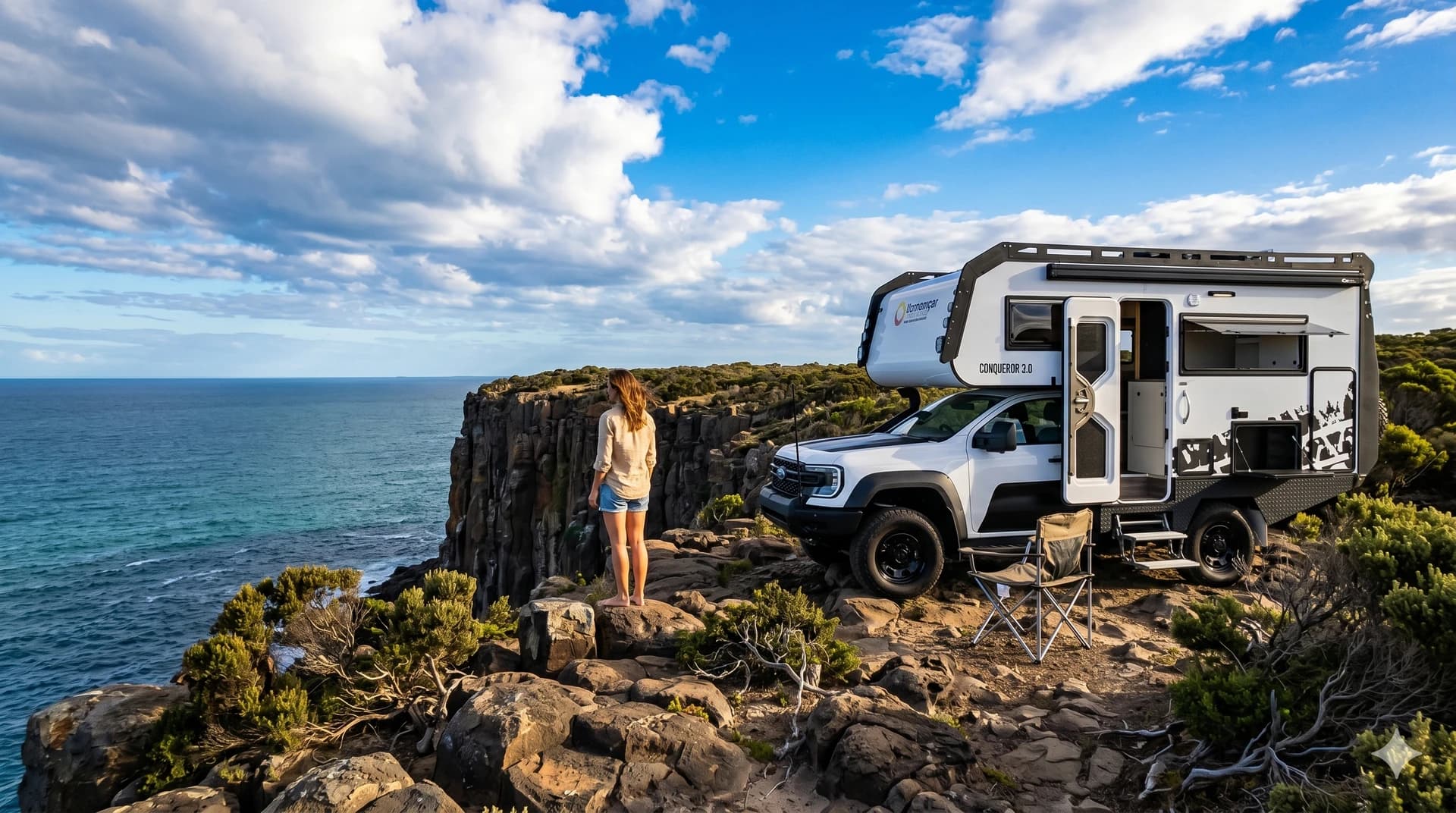
The Conqueror 3.0 offers 600Ah or 900Ah of lithium as a configuration choice, with 850w of solar as standard and 1,020w available as an upgrade. It is the most capable off-grid power system in the Sherwood range.
Saxby Range (V-2, S-2, X-2, F-2)
The Saxby range comes standard with AGM batteries and 260w of solar. A lithium battery upgrade is available as an individual accessory ($1,700, minus 30kg) and as part of the Sport Lite pack ($3,750, which includes the lithium upgrade and a 2,000w inverter) or the Sport Pack ($8,000, which adds an outside table, reversing sensors, external shower, and external box or bike rack). For Saxby buyers who want genuine off-grid capability, the Sport Lite pack with lithium and inverter is the most practical starting point. The F-2 shares the same pack structure and the same lithium upgrade path.
Sovereign Q-2 and P-2
The Sovereign range comes standard with 240Ah AGM batteries and 340w of solar. A lithium upgrade is available individually (adding 160Ah to make 400Ah total, at $2,400) or as part of the Living Plus pack, which upgrades the system to 600Ah alongside additional solar and other inclusions ($13,500). The Sovereign range is built for extended touring and full-time living. Buyers planning that type of use should consider upgrading to lithium at order stage rather than managing on AGM.
A Note on Inverters
Lithium batteries pair most effectively with a pure sine wave inverter. Without one, your battery bank can only run 12v appliances directly. An inverter converts 12v DC power to 240v AC, which means you can run a microwave, charge laptops and cameras, use a CPAP machine, or run any standard household appliance without being connected to shore power.
On the Conqueror 2.0, a 3,000w pure sine inverter is standard. On the Conqueror 3.0, a 3,000w or 5,000w inverter is available as a configuration choice. Across the Saxby range and the Sherwood R-2, E-2, and T-2, an inverter is an option. If you are upgrading to lithium, include an inverter at the same time.
The Honest Summary
AGM is a sensible, lower-cost starting point. If your touring is moderate, you use powered sites regularly, and budget matters, AGM works fine.
Lithium is the better long-term investment for anyone who wants to genuinely travel off-grid. More usable power, less weight, a significantly longer service life. The Conqueror 2.0 and Conqueror 3.0 are built around this from the ground up. The Saxby and Sovereign ranges offer a clear upgrade path at order stage.
The one thing to know: if a lithium battery goes flat in a remote location and you do not have 240v access, recovery is not as simple as starting the engine and driving. Size your system correctly for how you actually use it and that scenario stays theoretical. Talk to our team before you order. Power systems are much cheaper to get right at build stage than to change afterwards.
One more thing on lifespan: how long your battery actually lasts depends on your usage, your climate, and how deep you discharge it. Suncamper’s lithium batteries are covered under their own manufacturer’s warranty, not Suncamper’s structural build warranty, so check your specific battery manufacturer’s documentation for exact terms.